
By Jules Storr
One of the most persistent and universal challenges to the safety and quality of the care patients receive has been preventing health care-associated infections (HCAIs). These infections not only compromise patient outcomes, experiences and overall safety but also place a significant economic burden on healthcare systems.
Among the many elements of multimodal improvement strategies devised to address this issue over the years, one intervention stands out for its perceived simplicity and potential: involving patients. But what does this mean in reality? It’s now over 25 years since Maryanne McGuckin and colleagues published their findings on how “patient empowerment” might play out in the context of infection prevention and control (IPC). And yet it was only a few months ago that the first World Health Organization (WHO) global research agenda for hand hygiene improvement in health care: a Delphi consensus study was published. Within the final list of priority research items, patient participation and empowerment loomed large. One of the research recommendations was; to evaluate the optimal strategies for involving patients in the design and implementation of hand hygiene promotional activities.
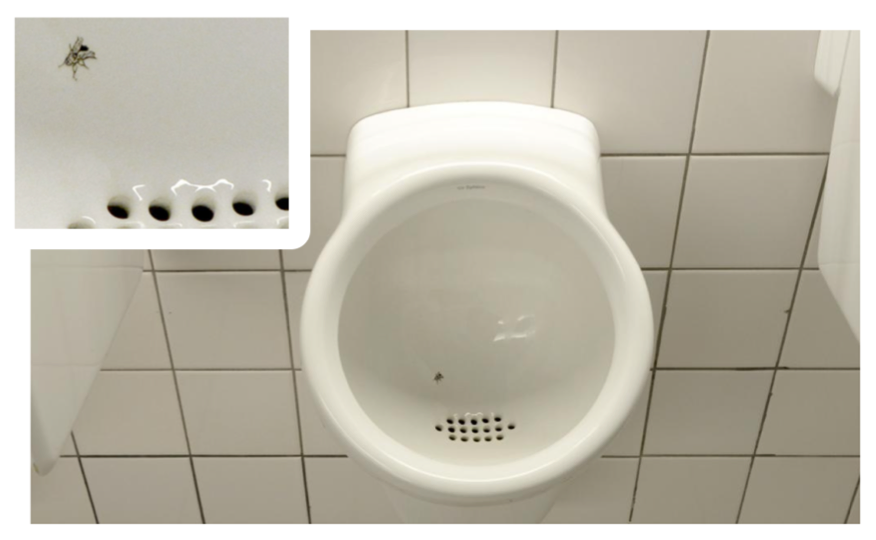
Behavioural change should be a central target of effective IPC and sometimes, the simplest ideas can seem to be the most powerful. Before behaviour change and nudge strategies became common parlance in IPC circles, Maryanne McGuckin used a compelling example in one of her presentations that came from an unexpected place: Amsterdam’s Schiphol Airport. Faced with the problem of poor aim at men’s urinals, a clever intervention was introduced – an image of a black housefly was etched near the urinal drain. This tiny visual cue led to an 80% reduction in spillage. The takeaway? People respond to cues that subtly guide their behaviour. This principle of behavioural nudging was thus adapted to IPC via Maryanne through the concept of patient empowerment, encouraging patients to play an active role in improving hygiene practices, particularly hand hygiene among healthcare workers.
A ground-breaking study in the UK circa 1999
The model for patient empowerment in hand hygiene originated in the U.S. and was adapted in a UK study known as Partners in Your Care. This intervention focused on three elements:
- Educating patients about the risks of HCAIs.
- Informing them how healthcare workers’ hand hygiene could reduce their own risk.
- Encouraging patients to ask healthcare workers, “Did you wash your hands?”
The results were promising. In the controlled study:
- 40% of patients agreed to participate.
- Hand hygiene increased by 50% overall.
- Compliance was higher among staff treating surgical patients.
- 62% of patients felt comfortable asking the question, and 78% received a positive response.
- While nurses were commonly asked, only 35% of patients questioned physicians.
These results highlighted not just the feasibility of patient engagement but its potential to elicit a tangible impact on healthcare worker behaviour.
Into the mid 2000s – from local innovation to national campaign
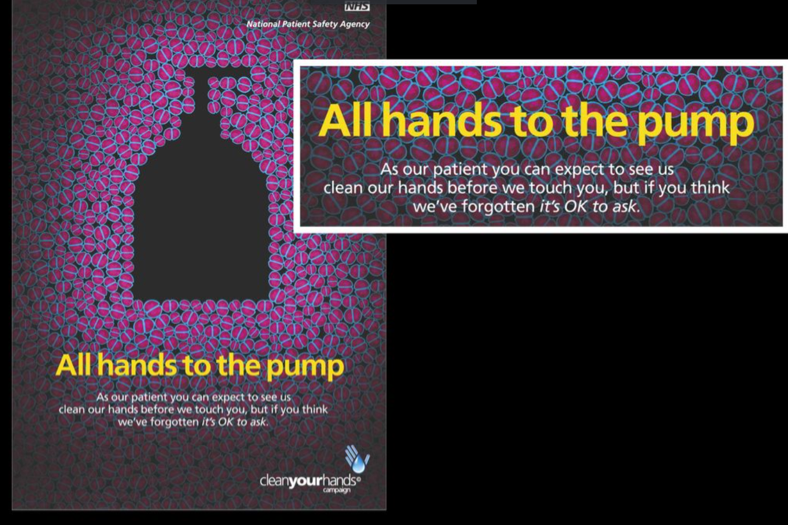
The success of this study inspired a broader national initiative in England and Wales: the cleanyourhands campaign. The campaign employed a multimodal strategy, drawing on Pittet’s Geneva model and included:
- Alcohol hand rub at every bedside.
- Posters and patient empowerment materials.
- Regular audits and hospital-wide engagement.
- A communications strategy that made it socially acceptable for patients to ask about hand hygiene.
One memorable campaign slogan was: “As our patient, you can expect to see us clean our hands before we touch you, but if you think we’ve forgotten, it’s OK to ask.” Even staff aprons and badges featured the phrase “It’s OK to ask,” reinforcing the message. Importantly, the hospitals joining the campaign had executive level commitment to all elements and to undergo a three month preparatory phase in which intense effort would be given to onboarding staff and nurturing champions. This was all in pursuit of strengthening a culture that valued the role of patient’s in IPC improvement. This latter point is often airbrushed out when we look back at the origins of patient involvement.
Independent evaluations confirmed the campaign’s success: a threefold increase in soap and alcohol hand rub procurement and a significant association between increased hand rub use and reduced MRSA bloodstream infections.
Global recognition and WHO’s 2009 guidelines
The potential value of patient involvement eventually gained international attention and patient engagement was included in the WHO’s Hand Hygiene Guidelines in Healthcare (2009), which emphasized:
- Shared responsibility and ownership.
- Creating a culture that supports empowerment.
- Acknowledging barriers to participation for both patients and healthcare workers.
- The importance of using culturally appropriate terminology (e.g., empowerment vs. participation).
The latter point in terminology is important. A number of terms are often used interchangeably but there are distinctions between empowerment, engagement, involvement and participation and these need to be considered. The guidelines furthermore underscored that successful patient involvement depends on the institutional culture and supportive environments for HCWs.
Barriers, biases, and the power of belief over the years
Over the years, despite evidence of its potential effectiveness, patient involvement in hand hygiene has continued to face scepticism. Surveys in the early 2010s showed that 57% of the public were unlikely to question doctors about hand hygiene – a statistic often cited as a reason not to pursue such initiatives.
The place for patient involvement in the 2020s
In 2015, Holly Seale and colleagues concluded, after another study, that patient engagement remains an underused method of preventing HCAI, and spoke of the deep-seated public fears about individual vulnerabilities that still need to be addressed
These deep seated fears persist to this day and it doesn’t take a genius to deduce that if the default response to the possibility of patient engagement is “it won’t work here,” then it probably won’t. But institutions that approach it with openness, planning, and a genuine commitment to cultural change are more likely to succeed. That’s the crux of the matter. Patient involvement is not a silver bullet, but as part of a multimodal improvement strategy (MMIS), it has real potential to support behaviour change and improve infection prevention outcomes.
For those with a genuine research interest in this subject – and it really still is an area ripe for further study – the WHO research agenda mentioned earlier is a great place to start. Here is the full list of what the experts said warranted further probing:
- The relationship between patient participation/empowerment strategies and the establishment of an institutional safety climate that values hand hygiene.
- The factors that motivate decision-makers/senior managers to involve patients within institutional strategies for improving hand hygiene.
- The impact of patient participation/empowerment on hand hygiene improvement including the influence of patient participation on hand hygiene improvement at different implementation stages (eg, program design and point of care).
- The relationship between national culture characteristics (especially dimensions of power distance and uncertainty avoidance) and patient participation/empowerment in hand hygiene initiatives.
- The most effective methods of patient participation/empowerment to improve institutional hand hygiene practices.
- Barriers and facilitators of patient participation/empowerment in hand hygiene interventions.
- The role and impact of visitors and informal caregivers in hand hygiene improvement.
- The perceptions of service users and patients towards an institutional safety climate and its impact on hand hygiene standards.
In the meantime, perhaps it’s time to just take a look again at the role that patients and their loved ones can play in IPC and HCAI prevention – not as passive recipients of care, but as equal partners in the creation of safer healthcare environments. It would be great to see people share their current experiences.