

The football, or more widely known, soccer World Cup has acted as a stimulus to reflect on some work we’ve done on infection prevention and control (IPC) across a range of healthcare settings.
Work to strengthen IPC programmes, specifically while understanding what enables progress and success through an approach to:
- diagnose the situation
- consider the “gold standard”
- review emerging patterns
- outline strategic opportunities.
When you look at a soccer match – clips on television, on social media – it’s easy to interpret (or misinterpret) the different roles of the different individuals involved, according to the gold standard – essentially, stopping the opposition from scoring a goal. Think Scotland versus Brazil!
Take that one person standing in the goal.
It appears that everything ultimately hinges on that one person. What you see is that they have a clear and simple task. To do the right thing, they must stop the ball – save the goals.
When you look at the manager standing on the side-line…
You see them watching the game. It appears that when the starting whistle blows they are a passive instrument, a bystander, just watching. But there’s so much more to this than what we’re immediately observing.
When we think about IPC:
- The default is to think that it’s comprised mainly of a number of preventative and controlling measures which an individual has to do to stop infections.
- Measures that centre around the insertion and care of intravascular devices and urinary catheters, or the performance of surgery and the care of wounds and skin, oral care, respiratory and gastrointestinal interventions, to name but a few.
- These measures tend to centre on what we call standard precautions.
- Our efforts are mostly to get people to take these measures, within the complex system of health care.
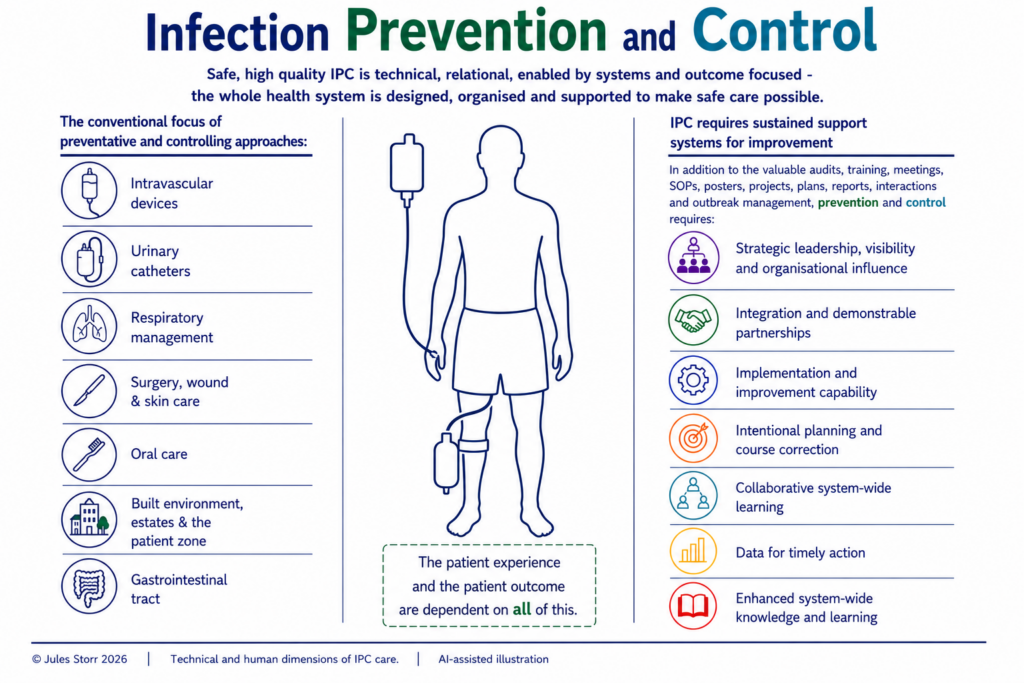
Introducing the term “complex system” is deliberate.
- Understanding the relevance of this to IPC is critical.
- Every individual health care worker fulfils their daily work within a highly complex socio-technical system that influences their performance.
- This can be in a positive or negative way.
Policies, guidance and SOPs are one side of the story. These are important to guide the health worker in knowing and doing the right thing to stop infection. Alongside this there are audits, training, posters, meetings, projects, plans, reports, interactions, outbreak management, and all of the things that organisations do in the name of IPC. Like in sports, we have our playbook.
But to ensure consistent, reliable and effective IPC we need system level conditions to be in place as well, including:
· strategic leadership, visibility and organizational influence
· integration and working in partnership with other relevant disciplines
· implementation and improvement capability, alongside a systematic documented approach
· intentional, targeted real time IPC plans
· collaborative system wide learning (especially before spread of any new ideas)
· data for timely action
· enhanced system wide knowledge, including the right approach to achieving this.
These reflect some form of what is recommended by World Health Organization in the Global strategy and action plan and monitoring framework, and as such provide us with additional evidence-based actions, sitting alongside what is already known to constitute successful IPC programmes.
In the 21st century, IPC continues to require the highly technical skills and expertise of infection preventionists. But, alongside an appreciation of the need to embrace behavioural science, improvement methods and implementation science. Here I am reminded of the theatre production and more recently tv show – Dear England, telling the story of Gareth Southgate, former manager of the England national football team, and the culture surrounding the team. We need an understanding of all of these things because IPC is influenced by the health system and dynamics in which it exists. This thinking isn’t new, we have been talking about this since 2013, but acting to ensure this is embraced across all health systems does seem more and more pressing.
When Lionel Messi scored a hattrick against Algeria earlier in this World Cup, this was simply the visible end point of a larger system that involved the rest of the team, the manager, the medical teams, leadership, tacticians, coaches, team culture, training, match preparation, communication, equipment availability, recruitment, data and analytics and all of the necessary support staff. The goal was scored by an individual but would not be possible without an entire system around that person that had all of the conditions for success.
So, like a football manager watching the game unfold, how often do infection preventionists step back from the day-to-day pressures of IPC to observe, reflect and adapt?
- Are we spending enough time working on our IPC programme, not just in it?
- Do we understand the true strengths, weaknesses and maturity of our programme,
beyond infection rates, audits and assurance reports? - Are we paying attention to the whole team effort – leadership, culture, capability,
implementation and improvement – or only the final outcomes? - What early signals tell us that IPC is becoming more influential, reliable and
embedded across the organisation? - Do we really know who we need to influence and engage with (our stakeholders) and have we methodically mapped them so that we can be precise in our interactions and plans?
- If we were starting again tomorrow, what would we do differently?
In essence, is it time for some honest conversations in IPC, starting with the following; is there a danger that sometimes we focus too much on the final score at the expense of all of the things that determine the end result?