

Clean Hospitals Day 2026 – an approach to empowering the people who keep healthcare environments safe.
By Claire Kilpatrick.
“I spent the day working as a cleaner in our large teaching hospital. I suddenly realized that cleaners have a superpower.I became invisible. Nobody talked to me or seemed interested in what I was doing or that I even existed.”
These are the real words of a UK paediatric surgeon who I heard speak in 2023. There is a paradox here. How often do we talk about a clean environment in health care being important? And how often do we hear shocking stories that reveal a different reality?
So, is it still time for a renewed focus on cleaning, and the role of cleaners in particular? The Clean Hospitals initiative thinks so! Their theme for the dedicated day on 20 October 2026 is “empowerment”. This reflects work by Suzanne Cross, Giorgia Gon et al who have highlighted over the course of a number of years the invisibility of cleaners and how their empowerment is one key part to clean and safe environments.
At the recent APCI and International Federation of Infection Control (IFIC) conference held in Cluj, Romania, I asked the audience to invest 30 minutes of their time to listen to my presentation, in return for one or two refreshed ideas; on how to improve environmental cleaning, with a focus on the word how, and empowerment of cleaners in particular.
I presented this session for two reasons; 1) because cleaning often still falls well below the standards we should expect in all countries (photographs of a dirty room in a high-income country that I showed on screen told just one story of this), 2) and because there are already so many resources available for our toolboxes that we should (re)consider an approach to using these more effectively going forward – the “how”. It has been my privilege to be involved in developing a number of the existing resources and it was a great pleasure to engage colleagues on this in Romania.
Data that still shocks
It’s not just photographs of poorly cleaned areas that tell the story that we need to address.
The WHO/unicef Joint Monitoring Programme published a flagship report in August 2026—Progress on water, sanitation, hygiene, environmental cleaning and waste management in health care facilities 2015–2025—providing the first-ever global estimates for all five basic WASH service areas, including environmental cleaning.
Global Status for Environmental Cleaning (2025 Data):
- Basic Standard Coverage: Only 59% of health care facilities worldwide met the basic standard for environmental cleaning in patient rooms, wards, operating theatres, examination areas, and toilets.
- Data Availability: Global country-level monitoring coverage for environmental cleaning remains low, tracked across just 54 countries.
Context to Other Services (2025):
- Basic water services: 85% (up from 76% in 2015)
- Basic hygiene services: 72% (up from 55% in 2015)
- Basic waste management: 71% (up from 59% in 2015)
- Basic sanitation services: 40% (first global estimate; lowest overall service).
In this regard, I explained to the audience that a few years ago we made a video, asking people what they thought of such global report numbers. Some examples of how these big numbers make people feel include:
- Shocked
- Disinterested
- Devastated
- Overwhelmed
- Concerned
- Motivated.
Back to “time for a renewed focus”. A paper that I published with colleagues in 2021 considered the importance placed on the role of hygiene, including cleaning, and those who clean, in health care facilities, and within the context of existing global data, guidelines and initiatives.
Importantly, it provided calls to action – to make the data work and for those who lead IPC and AMR and WASH to work together on this. We cannot just keep publishing shocking data with no change in the periods in between. We called for all the different people who develop guidelines and standards to work together better and not just on the guidelines but their advocacy efforts. Clean Hospitals Day is necessary, as are other campaign days in the year, but we propose that we can surely bring related campaigns together to maximise impact – the sum could be greater than its parts. Better alignment might even help tosecure investment for cleaning in health care. And finally, the paperasked, howcan we ramp up the existing research priorities and publications, especially from low and middle income countries? We believe these points are still relevant five years on, if we work together with our collective energy.
Taking action now
“Adequate microbiologic disinfection of surfaces can be achieved with appropriate cleaning procedures; however, implementation and adoption of these practices in real-world settings has been difficult and incomplete.” (Rock et al 2016).
In Romania, I focused on what we can do now, drawing on implementation and improvement science to strengthen environmental cleaning.
A critical starting point is understanding the barriers to good practice, an essential part of the WHO five-step implementation cycle. While barriers will vary between settings, a 2024 study across four countries identified challenges that many of us will recognise:
- Workforce challenges: Low pay, heavy workloads, high turnover and limited professional recognition, alongside the need for training that accommodates different literacy levels and learning needs.
- Poor integration and unclear responsibilities: Limited coordination between cleaners, clinical teams and IPC staff, sometimes compounded by outsourced cleaning arrangements and unclear division of responsibilities.
- Inappropriate training approaches: Insufficient use of practical, accessible and culturally relevant materials, including visual resources, demonstrations and modular training.
- Competing demands and task allocation: Unclear cleaning priorities, including high-touch surfaces, and insufficient preparation of clinical and auxiliary staff who share cleaning responsibilities.
- Limited leadership support: Inadequate attention to policies, contracts, supervision, staff development and communication between cleaning and clinical teams.
We also need to understand our starting point and measure progress over time – not just outcomes but our implementation and improvement approaches. Two useful resources which can reflect our situational analysis are the Healthcare Environmental Hygiene Self-Assessment Framework (HEHSAF) and the baseline assessment tool within WHO’s environmental cleaning training package.
Identification of barriers and these assessments are part of informing a practical, regularly reviewed implementation plan, alongside application of a multimodal improvement strategy. Such approaches bring together the organisational, educational, monitoring and behavioural elements needed to support change. Although the evidence remains limited in quality (particularly in low and middle income countries), multimodal improvement offers a valuable, structured approach to translating guidance into everyday practice.
Bringing this to life, I presented a scenario and example improvement actions at the conference in Romania. Here is a summary:
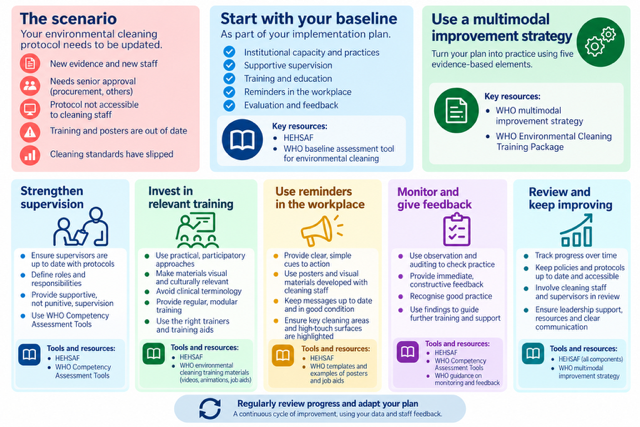
The focus of the WHO environmental cleaning package, from which many of the suggested tools in this scenario come, is on participatory methods for adult learning, and includes:
- The use of real-world case-studies
- Demonstrations or simulations, including the use of posters, photographs or animated videos to do this
- Group discussions and brainstorming through probing questions
- Question and answer sessions
- Completing example assessments
- Completing example competency checks through simulations or real-world observations and competency assessment forms.
Download the WHO package to compliment your work. Embed it into your implementation plans and improvement processes. Yes, this all takes time but using the build it, teach it, check it, sell it, live it improvement strategy and a five-step implementation cycle (first tested by WHO on hand hygiene and since applied more broadly to IPC interventions) is how we make the change we want to see and have cleaner, safer healthcare environments.
Because we want cleaners to no longer be invisible. Instead, appropriately trained and empowered.