
A blog by Claire Kilpatrick, Director at S3 Global Health, Global Health Consultant
There are a lot of “activities” that take place within an infection prevention and control (IPC) programme. A significant proportion of these activities are ultimately aimed at behaviour change; ensuring people implement guidance consistently and in a sustained manner to prevent infection.
IPC teams lead the way across all health care settings – often writing guidance and SOPs, and taking actions to facilitate implementation of their recommendations. They do not do this in isolation, and in many cases a network of champions and role models support IPC implementation. Periodically, IPC teams use activities such as campaigning to boost the profile of prevailing IPC issues, including participation in national or global campaigns. This is all about behaviour change.
Anecdotally however, it appears that sometimes IPC activities are not formally outlined in a programme of work. Sometimes IPC activities just feel like a long list of things to do, often appearing as disparate actions. Sometimes those actions can feel like they are mission critical but upon probing the rationale is not always clear. Sometimes people say – “I am just putting pressure on myself every day”. Sometimes activities seem to be based on pressure from those who don’t understand IPC. A lot of the time, they are triggered by the microorganisms that can cause avoidable patient harm, but this can also end in a vicious cycle of reacting and quick fixes, without an eye on sustainable behaviour change to stop future reactions.
Behaviour change isn’t easy, and is a science in its own right. And it might seem easier to keep doing the same things we’ve always done, for many reasons. My experience has been this, but I got drawn to behaviour change approaches many years ago and became committed to working with other experts to make this my focus. I even wrote a commentary with colleagues a number of years ago to commemorate World Hand Hygiene Day (WHHD), entitled – “Hand hygiene sounds easy, but not when it comes to behaviour change.”
So, here are a few questions to ponder in the spirit of embedding behaviour change within IPC programmes.
Do we all:
- Know the day to day barriers that get in the way of achieving effective IPC – both at the point of care and in the board room/c-suite?
- Know who and what influences day to day behaviours in all staff?
- Have a plan to connect with key influencers on a routine basis, including the language to use and the best mechanism of engagement?
- Look at role models and champions and consider how “on-message” they are on IPC – which is another way of asking – how do you know these key influencers are IPC-competent? More on this to come…
- Look at the built environment/estates and facilities and consider how behaviour change will be affected within the context of improvements to hospital, clinic, etc infrastructure?
- Consider who is best placed to do IPC audits? Is it a junior member of staff, is it an experienced IPC lead? Remember, hand hygiene, as one example, remains a complex behaviour change intervention in all our settings.
- Map out all that we are doing on IPC activities and present these in a way that speaks to senior management, leaders, influencers, the c-suite? Have we considered if there is organisational readiness and the right governance to support the change we need to see?
In light of these questions, I have been re-visiting the range of implementation and improvement manuals and tools that I have been privileged to write, alongside colleagues. The prompts within these resources, based on implementation science, really do make you think about all the things that are required to organize IPC activities, and ultimately influence decision makers and behaviour, at the point of care.
Returning to champions, the concept of IPC champions, role models, link nurses, etc has been around for a long time (around the 1990s). The World Health Organization (WHO) Core components for IPC programmes, published in 2016, states that “An effective part of a safety culture includes leadership engagement, identification of champions and positive reinforcement strategies; and increased accountability via monitoring and timely feedback.”
Reflecting on some of the literature on this subject, it’s clear that like with any other initiative that aims to influence behaviour, there are a number of things that should happen concurrently, including securing the right champions alongside organizational readiness to support their time and work.
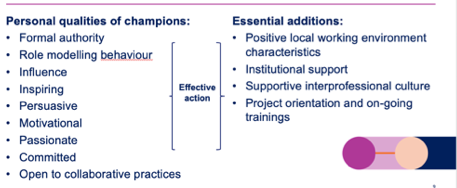
IPC champions are in fact one part of the IPC team. But if we don’t know what their focus of work is to be and if we don’t evaluate the impact, as part of the active, organised and systematic IPC programme of work, then the potential for behaviour change across the healthcare setting will be minimal.
Evaluating the role of champions might be as simple as reporting on the number of those active in the role, their disciplines locations and time commitment. However, Allegranzi et al published the WHO Global research agenda for hand hygiene improvement in health care: a Delphi consensus study in 2025 and four research priorities featured the role of champions:
- To evaluate optimal methods to train and educate health workers to become champions and role models for hand hygiene in the context of their area of specialty.
- The role of physicians as champions in providing feedback on hand hygiene compliance for medical colleagues, students and other professionals.
- The influence of hand hygiene champions/role models (people providing the example/advocating for the causes of patient safety and hand hygiene standards) on personal accountability for hand hygiene.
- The factors that influence the development (e.g., training, mentoring, attitudes, beliefs, values) of an effective hand hygiene champion.
I recently presented some of this information on a WHO Warming up for World Hand Hygiene Day webinar – you can listen to the recording here.
As also quoted on the webinar – “World hand hygiene day is a strategic moment of action with tangible impact. It still provides a key opportunity for all those working in infection prevention.”
World Hand Hygiene Day might just seem like one day where we talk about cleaning hands again, but it can be so much more than that. The actions that we take around that day, and the rest of the year, can influence behaviour change and save lives. That’s why we came up with the slogan “Action save lives” for WHHD, 5 May 2026. Find out more and access all the campaign resources here.