

By Jules Storr
What does it take to build an optimal infection prevention and control (IPC) service? If you asked a room full of IPC professionals – or, for that matter, a large language model like ChatGPT – you’d most likely solicit many confident and diverse answers. Yet beneath the surface of policies, frameworks and technical guidance lies a deeper truth: the elements that make an IPC service actually work in practice are also human and relational. IPC ultimately comes down to someone doing something differently.
This deceptively simple phrase has stayed with me for years since I first read it in a World Health Organisation (WHO) document on communication for behavioural impact. It captures the heart of IPC, patient safety and quality improvement: our work only matters if it changes behaviour at the precise point where care and treatment takes place. Behaviour change rarely happens because a perfectly crafted guideline lands in someone’s inbox.
What then, does it take?
I pondered this and other questions at the recent Federation of Infection Societies (FIS) conference in Bournemouth, UK.
A few years ago I took part in a global effort that came to be known as the Infection Prevention in 2030 Crystal Ball Initiative, led by Hugo Sax and Jonas Marschall. The group imagined the radical changes ahead – technological, organisational, cultural – and what IPC services will need to look like in the coming years to meet these challenges. As I prepared for the FIS talk, I recalled this initiative which acted as a reminder that optimal is not static. It evolves with context, complexity and expectation. I think perhaps that’s where the conversation needs to start.
Definitions
The dictionary defines optimal as the “best – most likely to bring success or advantage.” This is a useful start, but how does this apply in an IPC context? To try to answer this I posed the question – what would I receive if I asked everyone in the audience at FIS to email me with their thoughts on what comprises a killer, winning, ultra, optimal IPC service. I suspect no two answers would be identical. Some would begin with the evidence base, citing national and international guidance. Others might list quality assurance and other national and local frameworks. Some might emphasise frontline practice drawing on their own personal experience and examples to name but a few. All of them would be partly right.
The evidence: a solid foundation, but not the whole story
If we look at what the international evidence based guidance tells us then we arrive at what are referred to as the core components of IPC. These guidelines provide a clear blueprint for what an IPC program needs to have at its core to be effective. The structural essentials can be summarised as follows:
- A dedicated, trained IPC team with authority, resources and protected time
- A programme that includes surveillance, practice guidelines, training and education and monitoring mechanisms
- An enabling environment, addressing infrastructure and people
- And all of this underpinned by behaviour change science or what WHO refer to as multimodal strategies.
Most countries either work to these core component guidelines or have their own set of guidance that outline roughly the same requirements for IPC. But before drilling deeper into the issue of “optimal” it’s worth noting that a number of countries requested international advice on what might constitute the minimal requirements for IPC. As such, guidance also exists on what comprises the minimum things that should be in place for IPC to be good enough on the road to achieving the aforementioned core components. A fully active IPC programme obviously takes time to build. Countries can start with the minimum requirements/protections and then improve step by step in their journey towards full implementation of the eight IPC core components.
But the question lingers: will this ultimately be optimal, or simply still foundational? Before the session I asked ChatGPT, “Describe an optimal IPC service in two sentences.” The answer?
“An optimal IPC service is a proactive, intelligence-driven function that anticipates risks, prevents transmission through evidence-based strategy and design, and enables safe, reliable care beyond minimum standards. It continuously elevates performance by integrating real-time data, expert leadership and a culture of accountability that keeps the organisation ahead of emerging threats.”
This is not bad, actually. But I still think that this downplays the essential thing – the human bit.
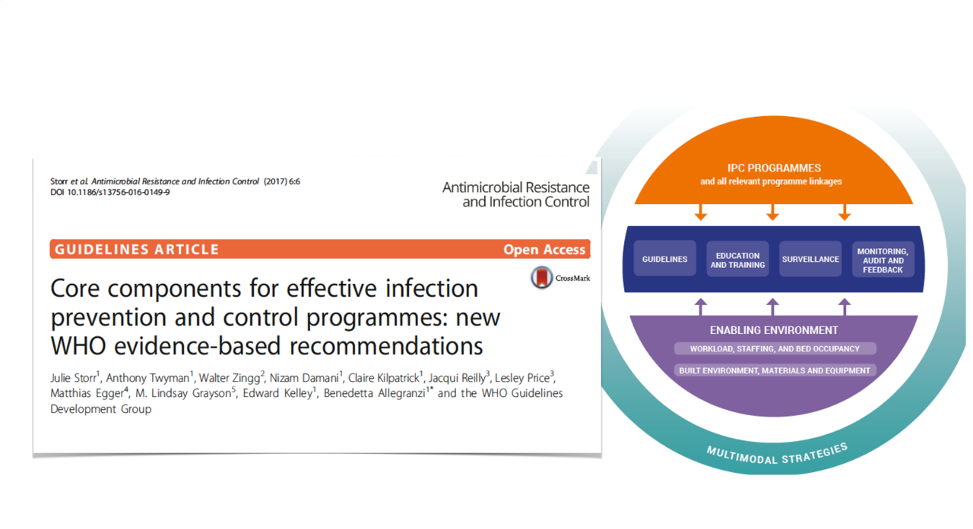
Some preliminary insights from existing work on optimal IPC services
In recent years I got involved in the Designing an Optimal IPC Service (DOIPS)project, led by Jude Robinson and working with Neil Wigglesworth, Jon Otter and Nic Cranley. It’s an ambitious attempt to move beyond structures and systems and pinpoint the softer, often neglected elements that differentiate a competent IPC service from an exceptional one. It builds on some legacy work that is worth exploring – this nice podcast episode with Emma Burnett will fill you in on what went before. Interestingly, Martin Kiernan informed me that it’s the second most downloaded podcast from Infection Control Matters – which must tell us something about the demand and the desire out in the real world for insights and intel on how to get from good to great.
Through research, consultation and interviews with high-performing IPC teams, three themes keep surfacing:
1. Leadership: The decisive factor
Leadership sits at the heart of every optimal IPC service. Interviewees consistently mentioned:
- Clear governance
- Strong, visible executive leadership
- IPC autonomy and trust
- Collaborative networks
- Nurse-led services in some institutions
- Leaders who communicate—not dictate
One striking line from a leader we interviewed:
“Effective IPC is a hearts-and-minds game. Leadership, culture and communication matter more than anything else.”
This echoes the 15-year Health Foundation review of IPC services led by Alison Holmes and colleagues: IPC requires distributed leadership – from the boardroom to the bedside.
2. Culture: The invisible architecture
Culture determines whether staff see IPC as a supportive partner or a policing force. Optimal services nurture:
- Visibility
- Engagement
- Open communication
- Psychological safety
- Empowerment
- Collaboration
- A focus on solutions, not blame
As one practitioner put it: “Be positive, be engaging, don’t judge.” Culture appears not to be a nice to have but rather it is the operating system of IPC.
3. Values: The glue that holds it all together
Values-based leadership is emerging as a defining characteristic of high-performing IPC teams. Interviewees spoke of:
- Shared values guiding decisions
- Soft skills in leadership and people management
- Recognition and celebration of success
- Building confidence to influence and advocate
- Human relationships as the core of IPC practice
One theme came through strongly: technical expertise alone is not enough. Soft skills are no longer optional – they are foundational and they are neglected in current training and development courses.
Looking ahead: IPC in 2030
Returning to the Crystal Ball initiative, my take is that the future of IPC is unmistakably human and requires a greater emphasis on soft skills, diplomacy, negotiation, listening, relationship-building and leadership
One colleague summed it up beautifully:
“First and foremost, IPC needs strong, effective leaders empowered to take IPC where it needs to go and get IPC understood by those who need to understand it.”
Technology will change. Data systems will evolve. Threats will come and go. But human relationships, trust and leadership will determine how well we navigate them in the quest for optimal IPC services.
So, what makes an IPC service truly optimal?
In the end, optimal IPC services build on the core components we already know, but go further. They invest in people, in culture and in relationships. They value the craft of leadership as much as the science of infection prevention. IPC services will succeed not solely because of policies and systems but because people who lead and implement these programmes care, connect, and take responsibility within the systems in which they function.